Showing posts with label writing. Show all posts

Jun 28, 2020

I prefer blooms

Dear Family and Friends,
This morning I came across the term doomscrolling, and I think I do it -- obsessively reading the bad news. I'm not sure I can stop. Maybe I don't even want to. I've been addicted to news since I was a kid, but I don't think it ever affected my mental state so long and deep as now. Maybe I shouldn't read online news sites for two hours each morning. (Yes! I do that!)

... on the other side of my brain, I paint.

Have you been doomscrolling?

Love,
k


Bright thoughts
8" x 8"
acrylic 


May 15, 2017

Can a writer be too tired to write?

Written this morning:

Dear Friends,

I was too tired to write last night… yes, that can happen, especially on a Sunday, which for me is nap day. Okay, I did nap, but I was still too tired. 

Patrick and Steph wanted to take me to someplace special for Mother’s Day, so I chose Chicago Fire pizza here in midtown. We had a big booth by the window, which was open to the street, so it was private but we could see action (passers-by and kids playing on the sidewalk) at the same time. Yes, they would have taken me anywhere … but you can’t beat perfect. 

Love,
k


Zing contemplates a side entrance to the Capitol
on our walk early this morning
(after 8 or so there are lots more people around)


May 12, 2017

Art to relax the heart

Written last night: 
Dear Friends,
This afternoon was another "Don't mess with me" moment. Don't ask me why, but my smile turned into a straight-lipped line, and my hobble became a stride. It seemed like people stepped aside for me on the sidewalk, and even Zing moved a little farther away down the sofa.

I'm sure you have such times too.  I just want you to know you're not alone.

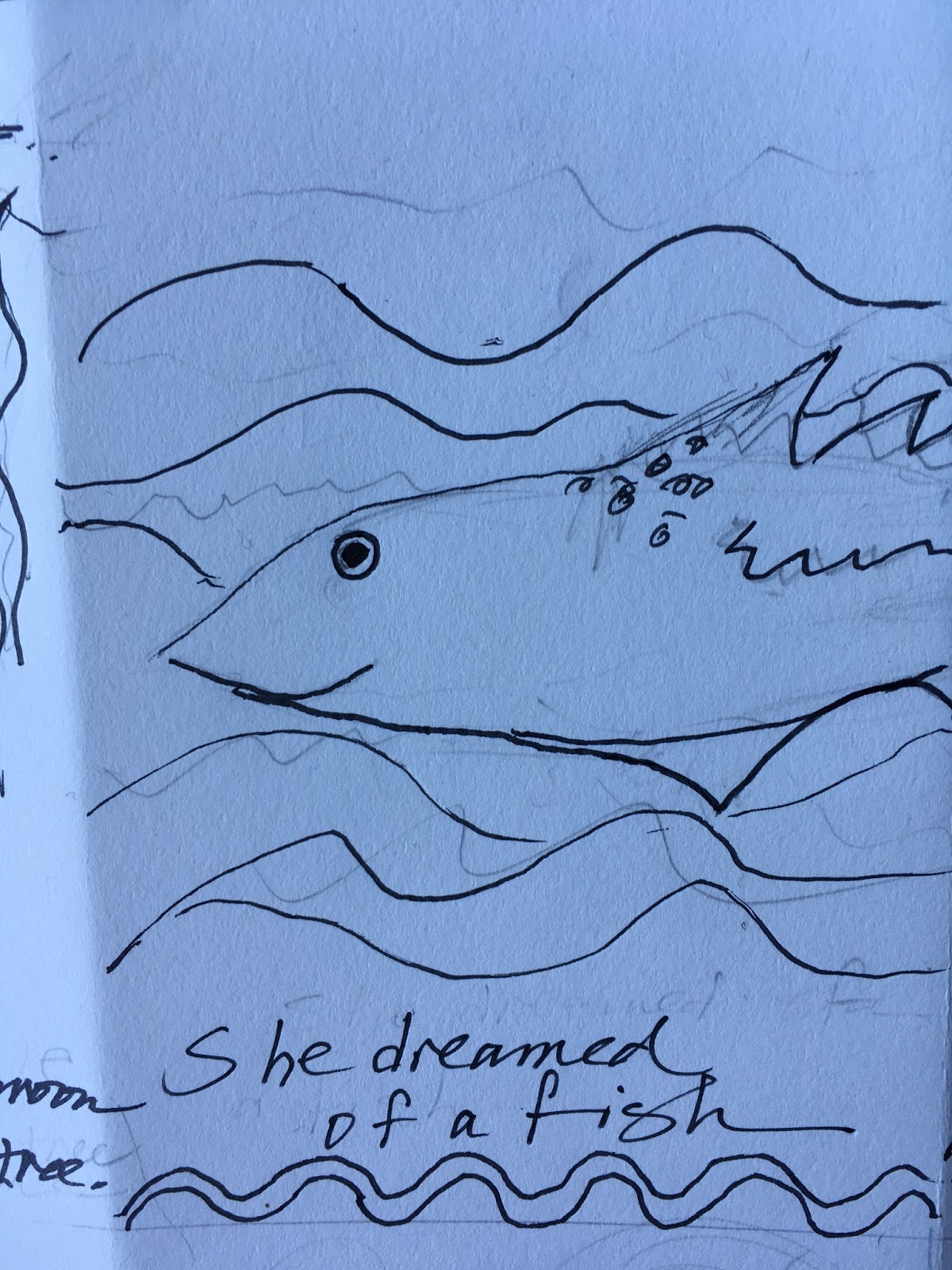
All's good now. People have been jumping into my path and smiling, talking, joking. And the drawing class this afternoon swept me into a story. We are making picture books. Here's my ditty:

Alexandra lives in a house by the sea.
She sleeps 'neath the moon and a tall palm tree.
She dreams of a fish.
She dreams of the sun.
She dreams of a boat that sails like a song.
When Alexandra wakes up
Her dreams are  done,
But she still has the boat/ and the fish/ and the sun.

Today I had art to relax my heart. I hope you are as lucky.

Love,
k
Here are some working sketches:


Jan 24, 2017

Connecting: the goods and the glitches

Written last night:

Dear Friends,

Eeeeek! If I lose my email address and therefore my connection with you, I’ll be back.  Comcast told me I’m losing it, but I refused to listen, so they passed me on to “Tier 2.” Whatever that is. So far I still have my email address…. I’m afraid to call Tier 2, wherever they are, to find out if this reprieve will last. Anyway, I have a seldom-used Google address (which I forget at the moment) and that will be my back-up. What I’m trying to say is I don’t want to lose our connection. You are my lifeline!

I have also begun calling people. Actually talking to people. And some of you have called me. I love it. Don’t stop. I’m not joking. Connecting with people I love has made all the difference to me. 

Another old-fashioned thing I’m doing is reading books — words on paper. I am a Kindle fan, but lately I love turning pages, writing notes in margins.  Reading is something I can do in response to the election of Trump. I want to learn stuff. Today I made a concrete plan: 30 minutes of practical reading — like learning about the iPad or the car — and an hour of reading a book. Today I did the first and not the second.

Love,
k

Sep 24, 2016

The words are out there somewhere, aren't they?

Written last night:

I just did one of those things where you erase everything you’ve written. (Yes, Mona -- Like you did the day before!) 


Briefly, it said I took an AARP safe driving class this morning. I thought it might give me some confidence, and it did. I left determined to re-adjust my side mirrors and to clean Rosa’s windows often, and to be decisive, not hesitant, when making turns. To be respectful of large trucks. To turn right more often than left… 

I’m going to take Zing out now. I try not to take this last walk too late. (But don’t worry — my street is well-lit and mostly empty of stragglers, and lined with first-floor residences.) Zing is asleep on a heap of pillows, but he loves this last walk. 

He told me he’s given up barking when I’m gone. I just say "No bark" as I head out the door, and give him a treat when I come back. "Good boy, no bark!" I say. I swear it's working. 

Tomorrow I’ll try to keep my words afloat. Happy Saturday! 

Love, 
k


Mar 16, 2016

Put more social in your media

"Get over it!" That's what Randi Atwood, the platform editor of the Tallahassee Democrat, told about 20 of us gathered around a table at COCA (Council on Culture and Arts) headquarters on Gaines Street last Tuesday night.  It was a workshop for the art community on Developing your social media voice. .

I need to get over being kind of backward when it comes to social media.
Did your mother admonish "Don't be pushy!"? Mine did.
Today Pushy is good, says Randi. Push your ideas, your merchandise, your art. Shy people lose!
Accept anyone who wants to be your Facebook friend. Like. Comment. Share. Video your technique. Dare your friends. Ask audacious questions. Climb onto today's bandwagon. Don't hold back.

I have some friends and cousins who refuse to do Facebook. They're afraid of people snooping on them. Or they say it feels like work, and they've had enough of That! OK for them. Peace be to them.

I love communicating, and want to use what's available. But I do remember a nice clackety-clack typewriter. Love that sound!

Straddling two worlds, I went to Randi's workshop hoping to learn why (after seven or eight years doing it) I don't write my blog more often. Should I? What good is it? Also, I wanted to know if I should post the same pictures of my art on Instagram and Facebook. Isn't that overkill? How do Facebook and Instagram differ?

I found out that social media is good for selling: myself, my pictures, my ideas.
I'm kind of programmed to step back, not forward. So this is a stretch. But I'm doing it. Thanks, Randi!

Randi is the future. The future is now. Here are some highlights:

  1. "Blogs are not social media," OK, Randi! I get it -- My blog doesn't offer the immediate give-and-take that defines social media. So I should say how a blog can help me, and then decide whether to keep it up or not. (I'm keeping it, obviously.) And really, one reason I don't write my blog more is that I love my iPad, but the blog works best if I create on my Mac. Got to keep the Mac handy. I'm not really selling anything, which is a big reason for blogs. However, I like to assimilate my thoughts in writing. I like to record my techniques: which paint did I use?  ... details that make it easier next time. Also, recipes I love! Maybe album-style family events. I love to make things, and not just for me. Mostly, I love to share: my thrills, creations, food.  I'll let the blog work for me.
  2. Don't use all the venues -- Concentrate on a couple-- say Instagram and Facebook -- and get really good. You shouldn't be on everything. bye-bye, Twitter! 
  3. Don't be boring. social media is a conversation, not an annual report. (Or maybe not a news story either, which is what I seem to write. Or poems.) Write like you talk. Chat. 
  4. Social media is all about give and take. It's a conversation, remember? Someone says something, someone else responds. I thought writing was to read. Wrong! Your thoughts will live! Maybe come back to haunt you.
  5.  Randi says don't use exclamation marks in excess. Or maybe never, if you want to look really grown up. 
  6. Facebook loves algorithms (Didn't I get A's in college math? Then why am I so blank about this? Oh, years have passed, you say?). Anyway, algorithms determine who gets to see your posts. Algorithms like videos best. They eat up videos and spit them out everywhere. Next, the Algorithm Monster likes pictures and comments. And Shares, of course. If you get lots of Shares, Facebook loves you. In other words, the farther you make your posts spread, the farther Facebook makes them spread. So make an effort. Respond to people. Ask them to respond to you. Beg them even.
  7. And if you're marketing something -- the Orchid Show say -- you should know about Boosting. My techno-friend Randi recommends it. Strongly. Look into Boosting. It means you pay a little -- say, $20 -- and get to tell Facebook where to go. Literally. Facebook will send your post to whoever you say. It takes a little work. Look it up. Google it: Boosting.

There's more, but that'll do for now."At'll do" ... as Grandma Frey used to say when we'd had just enough of this for now.


Jun 12, 2014

A month of tiny projects

Vacation cottage

It's been a few years since I made this little quilt of our cottage at Jensen's in Captiva, FL. The piece was part of a month-long project I'd forgotten about. But this morning, as I was searching my files for an old poem, I stumbled on a how-to piece I'd saved. I liked what it said. Then it dawned on me that of course I liked it -- I wrote it! It's about my month of tiny projects. Finding it has inspired me to do the same thing this summer.  Here it is:

I was drowning in a sea of ideas, techniques and materials to explore.  Then I tried a month of tiny projects. At the beginning I was a wanderer; at the end, people were calling me an artist. Working hard every day for a month without thinking too much about perfection gave me speed, discipline, and freedom to integrate my creative self. If you too feel fractured, try this.

It began one morning as I looked out my studio window while it was still dark. The full moon floating behind the pecan tree was so beautiful that I gasped. Right then I decided to make art every day for a month, starting with the pecan tree and moon.

Pecan tree and moon


Here’s the process:
Pick a schedule. Mine was a piece a day, but it could be weekly or even monthly.
Pick a theme. Mine was gratitude. I expected something amazing every day for my subject. Other themes might be: a dream a day, or a world event, or a visit to a new neighborhood or fresh piece of your city. Alternatively, you could be inspired by the same place (or person) over and over, noting subtle daily changes. Or make art based on the day’s recipe, or prayer, or confusion, or memory, or your first thought of the day. I want to make art about my evolving definition of God. Choose anything you want to explore. Don’t worry too much at this point.
Limit your size and/or materials. I decided to make 6 ½-inch squares that would be quilted – three layers that would have a muslin base and batting, with the top varied. For many I used the sewing machine. You could just as easily make a larger piece each day – say, every day’s work would involve some material you found in nature, like a branch or feather; or it could be based on a daily foot-square rubbing of some part of your neighborhood’s surface.
List techniques you want to explore. I was forever jamming the printer when I tried to copy a photograph onto fabric, so I wanted to master that machine! I also wanted to try out different ways of writing on fabric, and to work in three dimensions, and to alter fabric with stamps and markers and paint, and to make new surfaces from old materials, making faces, and to freely collage with fabric. And practice free-motion quilting.  You could explore color all month, or line, or another element.
List your inspiration. My inspiration was the poet A.R. Ammons, who said,

"Anything looked at closely becomes wonderful."

List references as you find them. I bookmarked web sites and put pertinent books and magazines in a special spot on the shelf. I saved only the most helpful web sites. As I learned to print on fabric, I explored many, but one was most helpful.
Be easy. I let a few days go blank. I needed some space to write about the pieces and write a poem. But I didn’t stop, not even while we took a week’s vacation at the beach. I packed small pieces of fabric and a tiny sewing kit that included glue, scissors, and muslin squares. Every day I worked on a picnic table outside our cottage.
Pretend you are not in charge. Let the day tell you what your subject is. The day we drove to Captiva Island had plenty of inspiration: the long trip, meeting old friends, and seeing the lovely Gulf of Mexico. But at 10 p.m., as a group of us were finishing a late dinner at a restaurant, we were shocked by a frightening flash, and then the island went dark. Naturally, this blackout was my subject, trumping all the other highlights of the day.
After it’s all finished, look for trends. What are your colors, lines, subjects? Much to my surprise, I didn’t use yellow! I seem to love layers and texture. I write messy. I want to explore printing. 
I want to do this again.

Nov 25, 2013

The Smartest Kids in the World

The Smartest Kids in the World: And How They Got That WayThe Smartest Kids in the World: And How They Got That Way by Amanda Ripley
My rating: 3 of 5 stars

Don't we all agree that education in the U.S. could use a fresh take? Amanda Ripley tells us what it's like to be an American exchange student in one of the countries where high schools are "better": Finland, South Korea, Poland.

A couple of months ago her book was much-discussed. Now it seems to be off the radar. But her observations have merit. Here are a few:
1. Ripley says local control is "hard-wired for inefficiency" ( p. 34).
2. Parents who engage kids in talk about big ideas -- movies, books, current affairs with teens especially -- will have kids who are better readers ( p. 108). Parent volunteering at school, on the other hand, does not seem to affect student achievement.
3. Read for pleasure and your kids are more likely to do it too.
4. Take education seriously -- more seriously than sports even.
5.  Make teaching a high-level profession in training, in both respect and pay.
6.  Have hard tests, especially a hard and useful matriculation test at the end of high school..
7. There must be meaningful opportunities for everyone. Equity is essential to good schools.
8. The best way to evaluate a school is not by word of mouth, but by visiting when school is in session.  Are the kids interested, paying attention, working hard? (208).
9. High school graduates  should be able to write an essay, develop an argument, and clearly communicate an idea. But many can't.

You've probably already heard that students work too hard in Korea, routinely studying in private tutoring offices until 9 p.m. before heading home. Ripley also reminds us that Korea and Finland have gone through hard times in recent history. They value education as a way out of that era. Americans, Ripley says, have been lulled by our country's wealth. We don't take education seriously.

I usually get mad at non-educators when they make recommendation, but Ripley keeps to her role as reporter; she doesn't really tell us what to do.


View all my reviews

Aug 17, 2013

Every Love Story is a Ghost Story


Every Love Story Is a Ghost Story: A Life of David Foster WallaceEvery Love Story Is a Ghost Story: A Life of David Foster Wallace by D.T. Max
My rating: 3 of 5 stars


I don't appreciate the novels of DFWallace. Maybe I'm too old, simple, or female. His work was/is cutting edge, complex, and -- to my mind -- testosterone-laden.  But I did enjoy the story of his life, even though everyone knows it ends with his suicide. That horrific fact haunts each page. Wallace was part of a team of rivals who mixed up fiction when it needed new life.  He was so intelligent that it literally hurt. His brain was always trying to best itself. He was self-centered and needy and addictive. He was mentally ill. It took him forever to grow up, but he finally did. I like that the book shows his dedication to 12-step groups, how he depended on them for stability and found meaning there. This despite his sophistication. This book also shows how hard he worked to produce a novel, describing how sometimes, especially at the beginning, pages would just flow, while other times he would  wrench each word, only to then trash wads of writing in the quest for his best work. It told his hard work teaching college students creative writing, reminding me of the three-layer response to student work, the comments for each in a different color of ink: first impression, style, proof reading. Worst and pervasively, the book shows the depth of destruction that mental illness can bring you down to, no matter how dedicated you may be to your own recovery, no matter how brilliant, hardworking, or even how in love you may be.

It made me want to write.


View all my reviews

Oct 2, 2012

Enrique Martinez Celaya: Collected Writings and Interviews, 1990-2010Enrique Martinez Celaya: Collected Writings and Interviews, 1990-2010 by Enrique Martinez Celaya
My rating: 3 of 5 stars

Now that I read so much on the iPad, books themselves mean all the more to me.  This book feels good. I like the way the cover is elongated, then folded inside to the size of the book. The paper is creamy and has a tooth to it. The whole thing feels like a project, both intimate and austere.  Martínez Celaya himself autographed the title page with a narrow, slanted scratch.

And that's kind of the way he writes: it's more an incision than a view.  Simple and serious -- smart!  Lots of layers here.  Some people think visual artists can't use words, but this one can. Okay -- sometimes he's deeper than I like to delve. After all, he was getting his PhD in physics  when he abruptly (his parents thought!) chose art instead. Then he was a successful art professor at the fancy Pomona College in California, but eventually turned his back on that too

Now he has a slick studio (He would loathe the word slick -- but a recent video shows it is smooth and spare.)  in Miami's Wynwood district. I bought the book at Books & Books in Coral Gables -- mostly because C & I agree never to leave a bookstore without buying a book. I am glad.


View all my reviews

Feb 22, 2012

Distracted for good

A meander through learning -- the last paragraph is best. 

Playwright Hanif Kureishi, once at the bottom of his class, worries that education is lock-step, directing some away from their best talents.

http://www.nytimes.com/2012/02/19/opinion/sunday/the-art-of-distraction.html

Feb 19, 2012

Heart of Glass

Heart of Glass

No pulse, no
blood, no
hurt. Only
splinters.

Feb 18, 2012

My favorite poet & a meatloaf sandwich


In the awful moving of a shelf of books I came across poems of someone I love -- me!

Certain men won't cry
until they learn
a beloved dog
is going to die.

For lunch we had meatloaf sandwiches: buns, tomato slices, some shredded Napa cabbage and horseradish sauce. The meatloaf was good the first day too, with baked potatoes and broccoli, It  suited the gloomy day.

For a guide, I use Sarah Leah Chase's recipe from Nantucket Open-House Cookbook. She calls for flattening out the meat mixture and spiraling it around provolone and prosciutto, which I skip. I used grocery store meatloaf combo of chuck and pork, and I did not exactly measure the other ingredients. I didn't have tomato juice, so used broth and squeezed in a little tomato paste from a tube. Here's the basic recipe:

Sicilian Meatloaf

Mix (I used my hands.)
1 1/2 lb. ground sirloin
1 lb. ground veal
1 medium onion, chopped
4 coves garlic, minced
2 T. dried Italian herb blend
1/2 C. chopped parsley
2 1/2 C. fresh bread crumbs

Add
2 eggs
1 C. tomato juice
1 T. salt
2 tsp. or less pepper

Form into a loaf shape on a baking sheet or shallow casserole dish.
Bake at 350° for an hour, or until the center is not pink.


Feb 17, 2012

Where ideas live

One of my tutoring students wants to write good essays. It's fun to work with such a motivated person. It made me want to write an essay.  I wrote it for her.


Where Ideas Live

An essay is like a snug cottage. It is a small and comfortable dwelling for your thoughts. Like any home, the essay is an expression of the one who lives there. It is full of things that the author cares about. The writer chooses words like furniture. She wants each piece to be authentic and placed where it will look best. The essay, like a private home, may reveal secrets. It may hint or tell you outright something fresh that you never before suspected.

The essay’s introduction is its front porch. It welcomes the reader and gives a hint of what may be found inside. It makes the reader want to open the door and read more.

The paragraphs are rooms. Each one has a special purpose, or topic. It is important to place furniture in the appropriate room. The stove does not belong in the living room! In the same way, sentences and details ought to fit right in the paragraph. Sometimes you will have to do some moving around. For instance,  I had the second sentence (“It is a small and comfortable …  thoughts.”) in the ending paragraph. As I worked on this essay, the sentence seemed to fit much better where it is now.

The essay, like a little home, must have clarity and order or it will be a mess. You must sweep out unnecessary words. They are useless and confusing, like too much furniture.  For example, at first I began this essay with, “An essay is a lot like a snug little cottage.” When I read it over, I saw I could shorten the sentence without changing its meaning. It is also important that you can move easily from one paragraph to the next. The more you write, the tidier your essays will be.

The back door is the essay’s conclusion. Before you leave, you glance back quickly, reviewing all the rooms you just explored. You breathe in the atmosphere of this cottage – the colors and scents of the word that make up its particular style. One day you may come back again, but as you open the door you get the feeling you have had a satisfying visit. When you hear the click of the back-door latch behind you, you know you are finished.

There are many larger and more imposing structures in the great city called literature -– palaces that are books, and skyscrapers full of short stories. But if you look closely, chances are good that you will find the heart of each structure is a related collection of rooms, or topics, each explored in a paragraph -- an essay.


Sep 23, 2011

Poet at a loss for words


My DyslexiaMy Dyslexia by Philip Schultz


Philip Schultz is telling me what it's like to be one of the students I tutor. He was a terrible student, often in trouble in school. He couldn't read until he was in fifth grade.  No one thought he'd end up a poet -- let alone a Pulitzer Prize winner. He'd been led to think of his predicament as a mix of stupidity and cussedness, with a tinge of insanity.  I've always been the opposite -- what my mom called a "bookworm." I naturally turned to writing and then teaching. Reading teachers are often people like me --  and we can't get inside the skin of people like Schultz. But he found the name for his predicament -- dyslexia -- not long ago. When he decided to start this book he got depressed. Dyslexia had woven itself into his life in deep and painful ways. Reading still gives him pain. But words give him pleasure. I am glad he finally wrote about how this can be.


View all my reviews

Blog Archive

About Me

My photo
I love to make things.